Recent

Rare and Exquisite Coins from Harry W. Bass, Jr. Collection Head to Auction, Benefiting Dallas Nonprofits

Rare and Exquisite Coins from Harry W. Bass, Jr. Collection Head to Auction, Benefiting Dallas Nonprofits

1907 Double Eagle Soars in Heritage Auction from Bass Collection

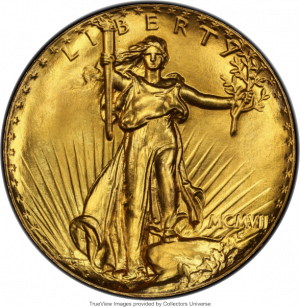
Heritage Auctions is excited to announce that a remarkable collection of rare coins from the esteemed Harry W. Bass, Jr. Collection will be up for auction on August 10th through Heritage Auctions, an Event Auctioneer Partner of the ANA’s World Fair of Money. Among the highlights is the highly-graded 1907 Ultra High Relief Double Eagle, PR69, which is tied for the finest known example.

The proceeds from this auction, as with the previous three auctions from the Bass Core Collection, will go towards supporting numerous Dallas-based nonprofits, with a special emphasis on early childhood education and literacy programs in the area. Harry Bass Jr., a passionate numismatic collector and a loyal resident of Dallas, dedicated much of his life to assembling one of the most extraordinary collections of U.S. Federal gold coins. Through the generosity of the Harry W. Bass Jr. Foundation, the Dallas community has already benefited from the $62.6 million raised in the previous auctions, and this auction will contribute further to this impressive total.

The featured 1907 Ultra High Relief Double Eagle is a truly exceptional coin. It was the first of its kind to be publicly offered in 1920 and has since remained out of public reach. Previously held in the renowned collections of John H. Clapp and Louis E. Eliasberg Sr., this rarity now presents a unique opportunity for collectors and enthusiasts to own a piece of history.

Another highly sought-after coin in the auction is the finest known 1829 Capped Head Left Half Eagle, PR66+ Cameo, which is the only proof 1829 Small Date half eagle in private hands. Notably, the last time an 1829 Capped Head Left half eagle was auctioned by Heritage Auctions, it fetched a record bid of $2.88 million. The rarity of this coin, combined with its exceptional condition, makes it a true standout in the numismatic world.

Other notable treasures include an 1828/7 Half Eagle, an 1799 $10 Large Obverse Stars, an 1863 Three Dollar, and an 1877 Fifty Dollar coin. Each of these coins represents a significant piece of history and rarity in the early U.S. gold series. The opportunity to own these exceptional coins rarely comes around, and collectors and enthusiasts are eagerly anticipating this auction.

The Harry W. Bass, Jr. Collection is not only a testament to the passion and dedication of its collector but also a remarkable philanthropic endeavor benefiting the local community. With each auction, the foundation continues to make a profound impact on early childhood education and literacy in Dallas. Don’t miss your chance to participate in this extraordinary event and contribute to a worthy cause.

For more information and to participate in the auction, visit the Heritage Auctions website.

Posted by News Release in Auctions, Recent
Safe Storage Tips For Your Gold

Safe Storage Tips For Your Gold

You bought gold. Now what? There are pros and cons when considering a home safe, bank deposit box, or bullion depository.

During the “Gold Rush of 2023,” dealers report that demand for gold bullion coins has soared from both previous investors and many new buyers. Now the important question is: how should you safely protect and store your precious metal purchases?

The Professional Numismatists Guild (www.PNGdealers.org), a nonprofit organization composed of many of the country’s top rare coin and precious metals dealers, advises that the three most popular methods of storage each have advantages and disadvantages.

“The secure storage methods usually considered by investors are a home safe, a safe deposit box at a bank or other financial institution, and/or a third-party bullion depository. Buyers of rare coins or gold, silver or platinum bullion coins or ingots should carefully consider which approach is best for them,” said PNG President Wayde Milas.

Here are comments from some PNG member-dealers about the pros and cons of different types of secure storage.

Home Safe – Pro:

Warren Mills of Rare Coins of New Hampshire in Milford, New Hampshire, disagrees about bank deposit boxes. “I always recommend home safe. If there’s a bank holiday, there goes your access. An insured home safe is the best option. Many homeowner policies offer up to a certain amount of a coverage rider at no premium or a reduced premium, and you can also obtain private insurance for a home safe.”

Mills also suggests installing a “dummy” safe visible in a bedroom closet “so your house doesn’t get wrecked if unfriendly people break in. A heavy. dummy safe lets them think they got the goods.”

“I recommend getting a safe with a minimum rating of Class C which provides at least 1 hour of tool resistance. Always with the caveat that although it’s your option, I discourage buying a gun safe. They can look fancy and strong but are generally rated A or B and do not provide the tool resistance of a Class C safe. Furthermore, insurance for bullion is not covered under your regular homeowner’s policy. A rider has to be purchased which can run thousands annually,” says Diane P Rapanotti of The Roamin’ Roman in Cabot, Arizona.

John Maben of Pegasus Coin & Jewelry in Bradenton, Florida is adamant: “I advise against any third-party storage and/or bank safe deposit boxes. You should be able to get your coins and precious metals quickly and easily. Only you and one other trusted person should know where they are kept. I suggest TL15 or TL30-rated safes or a highly concealed wall or floor safe.”

Maben adds: “Very wealthy people often have secret rooms in their house as well. Relinquishing any control of your coins and bullion is counter to the purpose of owning them.”

Home Safe – Con:

Tom Caldwell of Northeast Numismatics in Concord, Massachusetts cautions, “No home safe is completely safe from theft.  If the bad guys want them bad enough, they will find a way. If home storage is done make sure you have coverage on your homeowner’s policy or if this is exceeded get a rider on it.” 

“I would not keep everything in a home safe. Home safes can get blown away by tornadoes or hurricanes, and bad guys may tie you up and threaten or beat you and your family until you disclose the combination. Only leave a small number of items in a home safe,” warns Michael Fuljenz, president of Universal Coin & Bullion in Beaumont, Texas.

“If kept at home, items should be well hidden, and do not tell anyone about them.  An alarm system is recommended,” suggests Leidman.

Safe Deposit Box – Pro:

“The best storage method would be a safe deposit box in a bank or appropriate facility that has the same kind of security as a bank,” says PNG member Julian Leidman of Bonanza Coins in Silver Spring, Maryland.

“The only risk-free method is safe deposit boxes. Every other storage option has risks,” believes Caldwell. “The minor inconvenience of not having access to your coins to look at and enjoy when banks are closed is far offset by the added security of a safe deposit box.” 

Rapanotti points out that bank deposit boxes are a relatively low-cost, low-risk option for protection. “Many commercial coin and jewelry insurers give large discounts on their annual premiums if the bulk of the inventory is kept in a safe deposit box,” she explains.

“I’ve never personally known of anyone losing coins stored in a safe deposit box, but keep mum about the bank box and don’t be predictable about visits to the bank,” cautions Fuljenz. “Large safes are usually too heavy for thieves to carry, and also you should bolt the safe to the floor in an out-of-the-way location; not the master bedroom or bathroom because those are the first places thieves look.”

Safe Deposit Box – Con:

“The drawback is a bank safe deposit box is generally not available weekends or holidays,” says Rapanotti.

“Storing your rare coins or bullion coins in a bank is not convenient to view and enjoy your collection, so the option is to take images of the items so you can view them anytime,” Caldwell suggests.

Bullion Depository – Pro:

Twenty-four-hour, seven-days-a-week on-site security and surveillance may provide peace of mind about keeping your valuables in this type of third-party storage.

Bullion Depository – Con:

Caldwell says based on several bullion depository events of recent years “with third-party depositories there may be a chance of them going bad and you may be out of luck.”

“I never recommend third-party (depository) storage unless it is a qualified IRA account. The annual costs are high. Generally, your items are not immediately accessible due to documentation and signatory requirements,” says Rapanotti.

          Probably the worst place to store your bullion or rare coins is to bury them in the backyard. “Plastic tube containers and metal or wood boxes can leak over time resulting in environmental damage to the coins, and there are other risks with having valuables easily retrievable outside a locked and alarmed house,” says Fuljenz.

Members of the Professional Numismatists Guild and its Accredited Precious Metals Dealer program (www.APMDdealers.org) must adhere to a strict Code of Ethics (www.PNGdealers.org/code-of-ethics) in the buying and selling of numismatic merchandise.

Posted by News Release in Recent
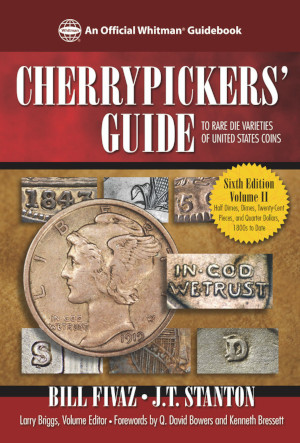
Ten Autographed Cherrypickers’ Guides Will Be Raffled at the ANA World’s Fair of Money

Ten Autographed Cherrypickers’ Guides Will Be Raffled at the ANA World’s Fair of Money

Whitman Publishing is launching the new sixth edition, volume II, of the Cherrypickers’ Guide to Rare Die Varieties at the American Numismatic Association World’s Fair of Money in Pittsburgh, August 8–12, 2023. A small quantity will be sold at the show, with a limit of one copy per customer. Ten copies will be raffled to lucky winners at the Whitman Publishing booth. After the show the new volume will be available from booksellers and retailers nationwide.

“We know how frustrating it is to experience a sell-out when quantities are limited,” said Whitman Publishing’s Dawn Burbank. “We want to make sure every collector at the ANA show has an equal chance to win the new Cherrypickers’ Guide if they’re not able to buy one. We’re reserving ten copies to raffle during the show, two per day, Tuesday through Saturday.”

The raffled books are dated and individually numbered, with bookplates autographed by author Bill Fivaz. For hobbyists who can’t attend the World’s Fair of Money, the 320-page spiralbound-hardcover book can be preordered for $39.95 online, including at Whitman.com. Delivery of preordered books will begin after the ANA show.

Posted by News Release in Books, Recent
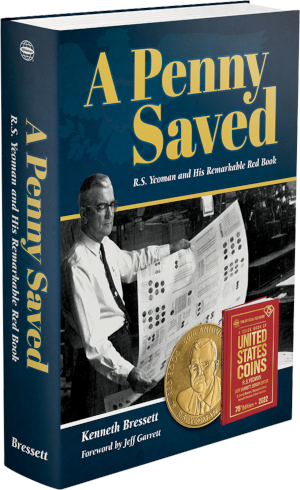
“Profit of the Mind”—R.S. Yeoman on How to Run a Good Coin Show

“Profit of the Mind”—R.S. Yeoman on How to Run a Good Coin Show

Kenneth Bressett’s memoir A Penny Saved: R.S. Yeoman and His Remarkable Red Book celebrates the life of his mentor, hobby legend Richard S. Yeo (known as R.S. Yeoman), and the longevity of the Guide Book of United States Coins (the “Red Book”), first published in 1946. The 352-page hardcover volume is available from bookstores and hobby shops and online (including at Whitman.com). This excerpt is from chapter 5, wherein Bressett shares a number of Yeoman’s writings. It was first published in the February–March 1964 issue of the Whitman Coin Supply Merchandiser. Yeoman talks about the importance of coin shows, the camaraderie they foster, and how to balance their objectives. He put these thoughts on paper 60 years ago—but they could have been written with equal wisdom today.

Whatever observation we make about the trend of coin collecting, the desire to assemble in large groups is clearly the most evident. Any week of the year, with a few obvious exceptions, there are one to ten coin shows in as many communities throughout the United States and Canada. It is a good trend, and those of us who supply the necessary accessories for arranging, protecting, and pricing coins, should encourage this kind of togetherness to the utmost.

The primary objective of the convention has been and probably will continue to be the selling and buying of coins. These gatherings are basically bourses, and most dealers derive an added benefit from making contacts with new and old customers. The sale of a coin folder or Blue Book to a novice collector is often the start of a long-term dealer-client association.

The future of the coin show or convention, however, rests on more than the bourse, and it is encouraging to see how some local club sponsors are keeping a happy balance between the dealer’s bourse, the auction, and the educational features. The show chairman is on the right track when he emphasizes exhibits and announces well in advance that handsome trophies or plaques will go to the winners. He knows that newcomers to the numismatic ranks are quickly brought into the show when the local newspaper, radio, and TV announces a free exhibit of rare coins.

We have noticed that the best attendance comes to those coin shows that have a modest or free registration, accessible display room, cordial committee members to answer questions, and a place to rest when the feet start to tire. One feature in particular has been offered by only a few conventions, and that is a special educational forum. Sometimes a panel of two to four well-informed individuals can do more to further the hobby than all the coin investment plans ever devised. There ought to be more of this kind of thing.

Our hobby can be torn apart very thoroughly if the profit motive continues to be over-emphasized to the exclusion of educational features. Competitive displays, authoritative lectures, mind-stimulating forums, and displays of available numismatic literature are convention attractions that can strengthen and perpetuate the ranks of the coin collecting fraternity. Let us have both school and marketplace, but in the right proportion. Perhaps we can plan our conventions this year with more emphasis on profit of the mind.

Posted by News Release in Books, Recent
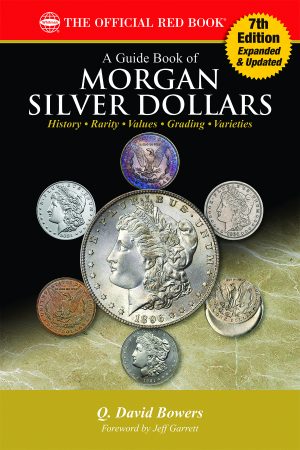
Q. David Bowers’s New Guide Book of Morgan Silver Dollars Back Story

Q. David Bowers’s New Guide Book of Morgan Silver Dollars Back Story

The seventh edition of Whitman Publishing’s best-selling Guide Book of Morgan Silver Dollars, by Q. David Bowers, is on sale now, available from booksellers and hobby shops nationwide. Here, Whitman publisher Dennis Tucker discusses the new volume in the context of the hobby’s fascination with these historic coins.

Ask collectors to rank the coins of the United States by popularity, and the famous Morgan silver dollar will always emerge at the top of the list. At Whitman Publishing we’re immersed in the coin’s universal appeal. Hobbyists buy thousands and thousands of albums, folders, and other holders to store and display their Morgan dollars. We get emails, letters, and phone calls about the hefty old coins. At coin shows, collectors, dealers, and investors are always talking about them. As we work on each year’s edition of the Guide Book of United States Coins (the “Red Book”), we hear plenty of Morgan dollar observations and market analysis from coin dealers around the country.

Meanwhile, outside the active hobby community, this is one of the “rare coins” that even non-collectors know about. They see them tossed in the air in a Hollywood Western, or for sale in a magazine ad, or nestled in Grandma’s purse. If Grandpa had a cigar box of old money, it likely included a Morgan dollar. Once this coin entered the American consciousness nearly 150 years ago, it never left. It’s a hard-money classic that sparks our imagination.

Given this widespread interest, it’s easy for a publisher to answer the question, “Why make yet another book about Morgan dollars?” In my opinion, America’s most popular coin deserves as many good books as the hobby community can read and enjoy. From observing the book market over the past 20-plus years, I believe that a rising tide lifts all ships when it comes to Morgan dollars. Because of the hobby’s longstanding interest in these coins, each new Morgan dollar book starts out with the potential of a built-in audience. If the book is fun to read and gives valuable information, it will create even more excitement around its already popular subject.

It’s kind of like the Treasury Department’s sale of its warehoused hoards of Morgan dollars in the 1960s and ’70s. Far from glutting the market and depressing prices, the mountains of coins were eagerly bought up, enthusiasm skyrocketed, and values began to rise.

Dave Bowers Creates a New Best-Seller

Q. David Bowers’s Guide Book of Morgan Silver Dollars, billed as “A Complete History and Price Guide,” is the popular standard reference in the field. The first edition was published almost twenty years ago, in 2004. Of course, by then Bowers was widely recognized as a subject-matter expert (not just for Morgan dollars, but across all aspects of U.S. numismatics). His published work on these coins goes back decades; a short list includes the Comprehensive U.S. Silver Dollar Encyclopedia (1992) and the hugely popular two-volume Silver Dollars and Trade Dollars of the United States: A Complete Encyclopedia (1993), not to mention numerous chapters, essays, and articles published in other books and in hobby newspapers, journals, and magazines.

The second edition of this guide book followed in 2005 with updated pricing and certified-coin population data. A new appendix studied the Morgan dollar patterns of 1878.

In 2007 Whitman published the third edition. By this time the modern renaissance in numismatic publishing was well under way. Black-and-white photographs were no longer acceptable to the hobby community; the third edition was published in full color. Again the book’s coin-by-coin pricing was updated, reflecting the active market, and certified populations captured the latest data. New research was incorporated into the manuscript—Morgan dollars are a popular field of study with frequent new discoveries. We improved the book’s layout and typography to make it as pleasantly readable as possible and easy for the reader to navigate.

The fourth edition came out in 2012. Again fully updated and revised, the new edition added an illustrated appendix of misstruck and error Morgan dollars, showcasing some truly remarkable coins including double strikes and off-centers, along with advice to guide smart purchases.

What did the hobby community think of Morgan dollars at this point? The fourth edition’s updated pricing reflected continuing enthusiasm. Many common dates had increased in retail price by 50 percent or more since the book’s first edition debuted eight years earlier, and rare dates and varieties had doubled—or more—in value. The Morgan dollar remained the King of American Coins.

Other New Morgan Dollar Books

By the time the Guide Book of Morgan Silver Dollars established itself as the coin’s modern standard reference, other Whitman books had joined the party. In late 2009 (with a copyright date of 2010) we published Carson City Morgan Dollars: Featuring the Coins of the GSA Hoard, by Adam Crum, Selby Ungar, and Jeff Oxman. “This book begins with the accidental discovery of gold in California in 1848,” we announced at its release. “The struggles of adventurers in the Gold Rush . . . the Nevada silver boom of the late 1800s . . . the creation of the Carson City Mint . . . these are some of the rich historical veins that Crum, Ungar, and Oxman mine in Carson City Morgan Dollars.”

Carson City Morgan Dollars was expanded and revised in a second edition released in 2011, then updated to a third edition that debuted at the American Numismatic Association’s National Money Show held in Atlanta in March 2014. Even with its specific focus on a subset of Morgan dollars, there was plenty of new material to enhance the new edition. It was updated with additional historical photographs, revisions from ongoing research, new coin values and certified-coin populations, and fresh market commentary. A fourth edition was published in 2018, expanded by 24 pages with a photographic gallery of the Carson City Mint, a review of other coins minted there, a study of Morgan dollar values in the late 1940s, and other updates and additions.

In November 2012 (copyright date of 2013) Whitman published The Private Sketchbook of George T. Morgan, America’s Silver Dollar Artist, a remarkable new book made in cooperation with the Smithsonian Institution. “Today most collectors know Morgan as the father of this legendary silver coin,” we noted. “Some specialists are familiar with his designs for commemoratives and medals, and his significant work in U.S. pattern coins. But who exactly was George T. Morgan? Karen M. Lee, a curator of the National Numismatic Collection housed at the National Museum of American History, finally answers that intriguing question. Introducing Morgan’s never-before-published personal sketchbook, and with unique access to family photographs and documents, Lee reveals the man behind the coins. The Private Sketchbook of George T. Morgan is an eye-opening immersion into what Lee calls the designer’s ‘life of art and labor.’”

This book, like the others mentioned herein, went on to win literary awards.

Next, in 2014, a new Whitman book was published, authored by Michael “Miles” Standish assisted by the research/writing team of Charles Morgan and Hubert Walker. In Morgan Dollar: America’s Love Affair With a Legendary Coin, various sections discuss the United States during the Morgan dollar era; the anatomy of the coin’s design; a market study going back to 1946; a year-by-year analysis of the series, including Philadelphia, New Orleans, Carson City, Denver, and San Francisco coins; and Morgan dollar Proofs.

An Exciting Development, and a Fast Sellout!

The fifth edition of Bowers’s Guide Book of Morgan Silver Dollars debuted in September 2016. It featured the requisite updated pricing, a useful new index, fresh illustrations, and exciting news of a startling discovery: information never before published, the story of the 1964 Morgan dollar. This made national headlines, stirred up the hobby’s imagination, and got people talking. (Would we expect anything less from the wonderful and legendary Morgan dollar?)

Until the fifth edition of the Guide Book was published, the hobby community was unaware that dies, hubs, and models for a 1964 Morgan dollar exist deep in the vaults of the Philadelphia Mint. We featured a hub for the 1964 Morgan on the cover of the book, with more photographs and details of the bombshell discovery inside. This discovery was announced in late August 2016, and demand for the new book skyrocketed even before it debuted in September, causing a temporary sellout. We ordered thousands of more copies to be shipped from our printer for distribution that October.

In 2019 the sixth edition continued the ongoing exploration, conversation, and fascination with these classic coins. We dramatically expanded our coverage of the 1964 Morgan dollar, and increased the scope of the index (a helpful tool for navigating the book). A new appendix described a serious threat to the hobby: counterfeit coins. And again we updated the coin-by-coin catalog with current pricing and new certified-population data.

The Newest Edition of Bowers

Today Dave Bowers’s Guide Book of Morgan Silver Dollars is in its seventh edition. This latest version has been expanded by 16 pages, to include more (and larger) illustrations of circulated and Mint State grades; a gallery of toned coins; a new appendix on counterfeit Morgan dollars based on the work of retired Coin World editor Beth Deisher; a new appendix on the 1921–2021 anniversary coins; an expanded index; and a completely updated portfolio of date-by-date coin photographs. The pricing and certified-population data in the coin-by-coin chapter was again updated in a snapshot of today’s market.

George T. Morgan’s classic dollar coin continues to capture the imaginations of collectors, investors, dealers, and everyday Americans. Readers of the Guide Book of Morgan Silver Dollars will find much to learn in this new edition of Dave Bowers’s popular study.

Posted by News Release in Books, Recent
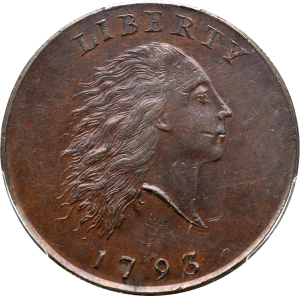
Heritage Auctions Awarded Legendary Walter J. Husak Collection of Large Cents

Heritage Auctions Awarded Legendary Walter J. Husak Collection of Large Cents

Revered assemblage from renowned numismatic collector will be offered by Heritage and Early Cents Auctions during January FUN convention

Heritage Auctions will offer a significant collection of large cents when the Collection of Walter J. Husak and the Liberty Cap Foundation crosses the block January 4, 2024, as part of the FUN Convention in Orlando, Florida.

The owner of HK Aerospace, in Burbank, California, Husak began collecting coins as a teenager in the 1950s and continued until his death last year. He purchased his first large cent — a rare 1804 Draped Bust, for $600 — in 1980, and began in the 1990s what became one of the most important collections of Sheldon varieties, which Heritage sold in 2008 for more than $10 million. In 2009, he founded the Liberty Cap Foundation to benefit American coin history research and education; at about the same time, he began his second large cent collection.

The auction at FUN will be conducted by Heritage Auctions, in partnership with Chris McCawley of Early Cents Auctions. Over the 15 years since his first collection sold, Husak reacquired 35 of the coins from the original assemblage.

“Walter Husak spent most of his life collecting and becoming an unquestioned expert on large cents and Sheldon varieties,” said Greg Rohan, President of Heritage Auctions. “It is only appropriate that a collection of this historical stature should be its own event.”

“In 2008, Heritage Auctions was pleased to present the first large cent collection that Walter Husak assembled,” Heritage Auctions Consignment Director Sam Foose said. “Like most collectors, ‘Walt,’ as he was known to his friends, was not finished collecting. His second collection was well on its way to completion when he passed away last year.”

Early Cents Auctions president Chris McCawley said the collection represents a clear selection of the elite examples of numerous coins.

“Early Cents Auctions is proud to partner with Heritage in the sale of the fabulous Walter Husak collection of U.S. Large Cents,” McCawley said. “The Walter Husak collection contains some of the finest early copper coins to come on the market in the last decade and a half, since the sale of Walter’s first collection in 2008, including possibly the finest set of 1794 Liberty Cap cents ever assembled, as well as many other choice rarities and finest-knowns.”

Heritage Senior Numismatist Mark Borckardt, a 50-year member of the Early American Coppers organization, wrote the first Husak Collection catalog and is working with Bob Grellman of Early American Cents on the present catalog.

“The auction will include more than 200 Sheldon variety large cents, many of which are the finest known examples,” Borckardt said. “Most of the coins have an outstanding provenance — there are even eight coins that have a continuous provenance to the 1790s, previously from William Strickland and the St. Oswald collection.”

Large cents, which are roughly the same size as half dollars that currently are in circulation, drew significant pursuit from numismatic collectors in the 1940s, ’50s and ’60s, and grew in popularity in part because of Sheldon’s 1949 book, Early American Cents — a survey of large cent varieties created from 1793 through 1814. 

Collectors will have opportunities to study the Husak collection before heading to Florida in January. The collection will be displayed June 22-24 at the Early American Coppers Annual Convention in Portland, Oregon, and August 9-12 at the ANA Convention in Pittsburgh.

Early Cents Auctions/ECA is a team of early copper specialists consisting of Chris Victor-McCawley, Bob Grellman, Lyle Engleson, Lucas Baldridge and Travis Hollon. Together they have participated in the sale of over $100 million dollars in classic early American copper coins including the collections of Robbie Brown, Ted Naftzger, Dan Holmes and the Missouri Cabinet. Images and information about all lots in the auction can be found at HA.com/1370.

Posted by News Release in Auctions, Recent
New Cherrypickers’ Guide, Sixth Edition, Volume II, to debut at the 2023 ANA World’s Fair of Money

New Cherrypickers’ Guide, Sixth Edition, Volume II, to debut at the 2023 ANA World’s Fair of Money

Whitman Publishing announces the upcoming release of the newest Cherrypickers’ Guide to Rare Die Varieties. The sixth edition, volume II, will debut in August 2023 at the American Numismatic Association World’s Fair of Money in Pittsburgh, Pennsylvania. In the meantime, the 320-page spiralbound-hardcover book can be preordered for $39.95 online, including at Whitman.com. After the ANA show, the Cherrypickers’ Guide will be available from booksellers nationwide.

To “cherrypick” is to examine coins that appear normal at first glance, seeking those with unusual characteristics—overdates, repunched mintmarks, doubled and tripled dies, and similar features—that reveal them to be rare and valuable. The Cherrypickers’ Guide uses close-up photographs and text descriptions to show collectors what to look for. It includes rarity ratings and retail values in multiple grades.

For the latest volume, Cherrypickers’ Guide coauthor Bill Fivaz and professional numismatist Larry Briggs coordinated edits and updates. They reached out to the hobby community for advice, recommendations, research, market analysis, and photographs. The new volume features more than 440 die varieties, including nearly 80 new additions. The book covers Capped Bust and Liberty Seated half dimes, dimes, and quarters; Barber dimes and quarters; Mercury dimes; Roosevelt dimes; twenty-cent pieces; Standing Liberty quarters; and Washington quarters, including the State, D.C., Territorial, and National Park series.

Picking up from there, volume III of the sixth edition is slated to debut in 2024. It will cover Capped Bust, Liberty Seated, and Barber half dollars, plus Liberty Walking, Franklin, and Kennedy half dollars, trade dollars, Morgan and Peace silver dollars, modern dollar coins, gold coins (dollars through double eagles), classic commemoratives, bullion, and coins struck for the Philippines under U.S. sovereignty.

Bill Fivaz, a coin collector since 1950, has earned recognition as one of the country’s most respected authorities on numismatic errors and die varieties. He is a longtime contributor to the Guide Book of United States Coins (the “Red Book”), a past governor of the American Numismatic Association, and a past member of the United States Mint’s Citizens Coinage Advisory Committee. With the late J.T. Stanton he published the first Cherrypickers’ Guide in 1990, launching the modern boom in interest in die varieties.

Volume editor Larry Briggs is well-known to the hobby community as a dealer, author, and educator. He was president of the American Numismatic Association’s Authentication Committee. A student of history and archaeology, Briggs served in the U.S. Air Force and worked for Ford Motor Company before launching his own business, Larry Briggs Rare Coins, in 1978. His specialties include error coins and die varieties, Liberty Seated coinage, and early American coppers.

Posted by News Release in Books, Recent
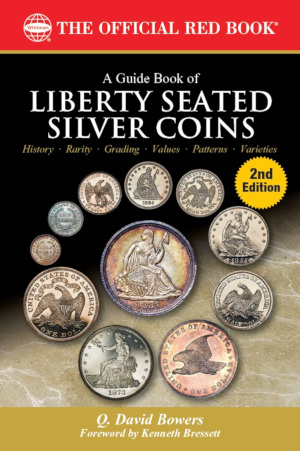
Second Edition of Q. David Bowers’s Guide Book of Liberty Seated Silver Coins Released

Second Edition of Q. David Bowers’s Guide Book of Liberty Seated Silver Coins Released

Whitman Publishing announces the upcoming release of the second edition of A Guide Book of Liberty Seated Silver Coins, by Q. David Bowers. The 608-page book will debut at the American Numismatic Association World’s Fair of Money in Pittsburgh, August 8, 2023. Before then it can be preordered online (including at www.Whitman.com) and after the show it will be available from booksellers and hobby shops nationwide, for $29.95.

The United States minted coins with the Liberty Seated design from 1836 to 1891. The motif was used on circulating half dimes, dimes, quarters, half dollars, and silver dollars, in addition to twenty-cent pieces, Gobrecht dollars, and, in modified form, U.S. trade dollars. Tens of millions of the coins were produced at the mints in Philadelphia, New Orleans, Carson City, and San Francisco. They were made from the Hard Times Era through the nation’s gold and silver rushes, the Civil War and its aftermath, and well into America’s Gilded Age.

As collectibles, Liberty Seated coins have been growing in popularity for years, with many enthusiastic collectors and students. The Liberty Seated Collectors Club (www.lsccweb.org) is among the hobby’s fastest-growing specialty groups. Leonard Augsburger, president of the club, who wrote the foreword to the first edition, stated that “Q. David Bowers offers both beginning and experienced numismatists a fresh perspective on collecting these fascinating silver coins.”

Bowers gives colorful historical context for the coins, describing the American scene (and the state of the coin-collecting hobby) from 1836 to 1891. Then he covers all eight coins that carried the Liberty Seated design, with a coin-by-coin catalog of more than 750 entries. These entries include mintages, auction records, and grade-by-grade market values for every coin. Bowers discusses grading standards, offers advice for building high-quality collections, and explores other factors important to collectors and investors. He describes each coin’s availability in Mint State and in circulated grades; characteristics of striking; pattern coins for each denomination; production, release, and distribution; branch-mint coinage; Proofs; die varieties; shipwreck finds; conservation; and more. The book is illustrated with more than 1,500 images.

Appendices include a chronology of coin designer Christian Gobrecht; an overview of the mints used to strike Liberty Seated coins; Mint directors and superintendents of the era; an account of a visit to the Philadelphia Mint in 1861; chief coiner Franklin Peale’s description of die making in 1855; a study of master dies and hubs by professional numismatist John Dannreuther; a look at alternative U.S. currency formats of the 1800s (Postage Currency, Standard Silver, and goloid dollars); and a catalog of die and hub trials and splashers, based on the work of Saul Teichman.

Kenneth Bressett, editor emeritus of the Guide Book of United States Coins, has said, “Reading a Q. David Bowers book will expand your knowledge and inspire you to broaden and deepen your own studies.”

Numismatist Rich Hundertmark, in the E-Gobrecht newsletter, wrote: “One of the challenges [of the Liberty Seated Collectors Club] is to attract and maintain its membership and pass down the learnings of experienced collectors to those new to Liberty Seated coinage. In this regard, I see great value in this book as a tool that can be used by collectors of all levels, both new and advanced. . . . The book’s photography and images are generally outstanding, and a few renderings of Liberty Seated imagery that I had not previously viewed include a Liberty oil-on-cardboard design that I found quite compelling.”

Because Whitman Publishing is the Official Supplier of the American Numismatic Association, ANA members receive 10% off the book when purchasing directly from the publisher. It can also be borrowed for free as a benefit of ANA membership, through the Dwight N. Manley Numismatic Library.

Posted by News Release in Books, Recent
Dannreuther’s United States Proof Coins Volume II: Nickel Released

Dannreuther’s United States Proof Coins Volume II: Nickel Released

United States Proof Coins Volume II: Nickel, the eagerly anticipated second in a series of four important reference books on U.S. proof coins authored by acclaimed numismatic researcher John W. Dannreuther, is now available.

The 374-page book with hundreds of full-color illustrations covers the proof varieties of Three Cent, Shield, Liberty Head (“V”), and Indian Head (Buffalo) nickels. High resolution photographs show every variety with either a full obverse and reverse image or micro close-up photographs of the date positions for the obverse dies as well as diagnostic characteristics of the reverse dies when paired with the same obverse.

The book’s foreword, written by Bernus (Bernie) Turner, states: “The world of collecting United States proof coinage has expanded with the publications authored by John Dannreuther, as these volumes contain new research and previously unpublished data on United States proof coins This latest publication expands that body of information to include nickel proof coins. I, for one, sincerely hope that many collectors start participating and share in this new enjoyable, exciting field of collecting proof coins not only by date, but also by the die varieties of the nickel coin series.”

Hardbound copies of United States Proof Coins Volume II: Nickel are available for $125 each, Postpaid. Orders can be placed online at www.orcararities.com or by email at orcararities@gmail.com.  A limited edition of 150 numbered leather bound books is planned for this summer.

The nickels proof coins book follows the 2018 publication of Dannreuther’s two-part gold proof reference work in 2018. Those who bought the two-part leather bound gold books will be able to have the same limited-edition book number inscribed on their nickel book if they reserve their copy before June 30.

The next volume in the proof coin reference books by Dannreuther will focus on U.S. silver Proofs from 1794 to 1922 and will be published in late 2024 or early 2025. He also is planning a book about copper Proofs.

John W. Dannreuther was a co-founder of Professional Coin Grading Service and an honored inductee in the PCGS CoinFacts Coin Dealer Hall of Fame. He was named the 2007 Numismatist of the Year by the American Numismatic Association, and in 2022 he received the highest honor given by the Numismatic Literary Guild, the Clemy Award.

Posted by News Release in Books, Recent
77th-Edition Guide Book of United States Coins Released

77th-Edition Guide Book of United States Coins Released

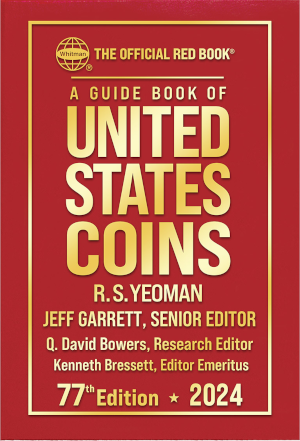
Whitman Publishing announces the release of the 2024 (77th edition) Guide Book of United States Coins, popularly known as the “Red Book.” The newest edition of the hobby’s best-selling reference is available from bookstores and hobby shops nationwide, and from online booksellers. The 472-page book comes in several formats including the classic red hardcover, two spiralbound versions (softcover and hardcover), and Large Print.

The Red Book prices nearly 8,000 coins and coin sets in up to 9 grades each, with more than 32,000 retail valuations in total. It has many new features and updated research, plus additions to the book’s 2,000-plus color photographs, which include enlarged close-ups of rare and valuable die varieties.

Coin collectors have used the Red Book to value their collections since the 1st edition was published in 1946. Today, Senior Editor Jeff Garrett coordinates the book’s advisory network of more than 120 professional coin dealers and researchers. Q. David Bowers serves as research editor, and Kenneth Bressett, who has worked on the Red Book since the 1950s, is editor emeritus.

The book covers legal-tender United States coins from 1792 to date, from copper half cents to $20 gold double eagles, commemoratives, and bullion, plus earlier coins and tokens that circulated in colonial times. With every new edition the latest coins from the United States Mint are updated—Lincoln cents, Jefferson nickels, Roosevelt dimes, America the Beautiful quarters, Kennedy half dollars, Native American dollars, American Innovation dollars, commemorative coins, bullion coins, and government-packaged coin sets. The book also includes popular specialized collectibles such as error coins, Civil War tokens, Confederate coins, Philippine coins struck under U.S. sovereignty, private and territorial gold pieces, pattern coins, Hawaiian and Puerto Rican coinage, Alaska tokens, So-Called Dollars, and special modern gold coins.

The Red Book is the world’s most popular annual retail price guide for U.S. coins, tokens, and other numismatic items. More than 25 million copies have been purchased since 1946, making it one of the best-selling nonfiction titles in the history of U.S. book publishing.

Posted by News Release in Books, Recent